Did you know the Bhimbetka rock shelters cover over 10 kilometers? They include seven hills with more than 750 rock shelters. Some shelters were homes over 100,000 years ago. They hold India’s oldest-known rock art from 10,000 BCE. Bhimbetka became a UNESCO World Heritage Site in 2003. It shows early human life and their culture. The site is 18.93 square kilometers big and has about 400 rock shelters. This makes Bhimbetka rock shelters important for learning history.
Key Takeaways
- Bhimbetka features over 750 rock shelters spanning 10 kilometers.
- Some shelters show evidence of habitation from over 100,000 years ago.
- The site includes rock art dating back to 10,000 BCE.
- Declared a UNESCO World Heritage Site in 2003.
- Rock art at Bhimbetka depicts scenes from hunting to historic battles.
Introduction to Bhimbetka Rock Shelters
The Bhimbetka rock shelters are very important early human sites in India. They show the great art and culture of ancient people. There are over 750 shelters in an area of 10 kilometers. This place has history going back more than 100,000 years. The art and findings tell us about old human life.
Location and Accessibility
The shelters are in the Raisen District of Madhya Pradesh, close to the Vindhya Range. They are 45 kilometers southeast of Bhopal. You can get there from Bhopal Airport, 55 kilometers away. There are places to stay near the shelters and in Bhopal city too. This makes your visit easy and fun.
Brief History
Found in 1888 and studied later, these shelters have been used since Acheulean times. The name “Bhimbetka” means “Bhima’s resting place.” It’s a UNESCO World Heritage site since 2003. The site shows human life through paintings from different times. Each period has its own style and subjects, teaching us about early human art and culture.
Visiting Bhimbetka lets you see other nearby places too. This includes the Satpura National Park and the Bhojpur temple. Bhimbetka is surrounded by beautiful nature and is important for history. It shows the lives of early humans in India’s heart.
Historical Significance of Bhimbetka Rock Shelters
The Bhimbetka Rock Shelters are a window to early human life. They are in Raisen district, Madhya Pradesh, India. These shelters have over 700 caves with many old findings.
UNESCO World Heritage Site Designation
In 2003, Bhimbetka became a UNESCO World Heritage site. It shows how ancient humans lived. There are over 15,000 paintings in 243 caves, some over 30,000 years old. They tell us about early humans’ lives and beliefs.
Early Human Settlements
Bhimbetka shows people lived here over 100,000 years ago. We find Stone Age tools here. Early paintings show animals, humans, and daily life, telling us communities were complex.
By 5,000 to 3,000 years ago, paintings show farming, trade, and metalwork. Art from 1,500 to 200 years ago shows how societies changed. Bhimbetka’s art takes us on a journey through time.
The UNESCO site of Bhimbetka highlights our ongoing cultural journey. It’s a look at human history that scholars and visitors find deep and rich.
Facts about Bhimbetka rock shelters
The Bhimbetka rock shelters are in the heart of India. They show us human history and cleverness. Found by Dr. V. S. Wakankar in 1958, they became a UNESCO World Heritage Site in 2003.
The area has seven hills and over 750 caves. But, only 12 caves can be seen by people. This place spans 10 kilometers. It has some of the oldest signs of people living there, from the Acheulian times.
The Bhimbetka rock shelters information tells us the shelters have old rock paintings. These artworks are from 12,000 to 1,000 years ago. They show hunting, dance, and nature.
The colors in the paintings came from nature. Things like manganese, hematite, and even animal fats were used.
There are more than 600 caves and shelters here. They give us lots of Bhimbetka rock shelters information. We learn about old cultures and how they advanced. The stone walls and big single rocks show the skill of Bhimbetka’s past people.
| Aspect | Details |
|---|---|
| Discovery | 1958 by Dr. V. S. Wakankar |
| World Heritage Site | Designated in 2003 |
| Total Number of Shelters | Over 750 |
| Open to Visitors | 12 shelters |
| Oldest painting | Approximately 12,000 years old |
| Materials Used | Manganese, Hematite, Wooden Coal, Plant Leaves, Animal Fats |
| Notable Shelters | The Auditorium Cave, Boar Rock, Zoo Rock |
| Periods Represented | Late Paleolithic to Medieval |
The Bhimbetka place is very special for archaeologists and history lovers. People have lived there for over 30,000 years. These shelters let us see into early people’s lives. They help us understand how human life evolved here.
Discovery and Archaeological Research
The Bhimbetka rock shelters are in the Vindhyan Hills. They caught people’s interest in the 19th century during British India. V. S. Wakankar found their prehistoric value in the mid-20th century. This began deep archaeological studies.
The Bhimbetka finds cover 1892 hectares, with over 750 shelters found. Yet, only 133 shelters have rock paintings. Researchers like Dr. V. S. Wakankar and Y. Mathpal found lots of rock art. They also found artifacts and signs of ancient human life going back over 100,000 years.
- Researchers found 2330 human figures in the rock art, from men to children.
- They found 1377 animal images showing about 29 species, like elephants, tigers, and rhinos.
- Scenes of battles and warriors were discovered, including 510 horse riders and 36 elephant riders.
The Bhimbetka rock art covers seven periods, from the Old Stone Age to Medieval times. Excavations gave us prehistoric tools and rock art of daily life, hunting, and rituals. This helps us understand early humans and their culture better.
Bhimbetka draws over 40,000 visitors a year today. Not many shelters are open to the public. This shows the need for ongoing preservation and study.
| Statistic | Detail |
|---|---|
| Human Figures | 2330 |
| Animal Images | 1377 (29 species) |
| Visitors Annually | 40,000+ |
| Shelters with Paintings | 133 out of 243 |
| Oldest Painting | 12,000+ years |
| Declared UNESCO World Heritage | 2003 |
Rock Art and Paintings at Bhimbetka
The Rock paintings at Bhimbetka show us ancient life through art. They capture cultural and spiritual moments from long ago. These artworks tell us about India’s first people in many ways.
Period I – Upper Paleolithic
The oldest art used green and dark red. It showed big animals and people hunting. The hunters used bows and arrows. This tells us how they lived.
Period II – Mesolithic
Art from 40,000 B.C.E. was complex. We see group hunts, dancing, and home life. They made red and white colors from minerals.
Period III – Chalcolithic
Art from the Chalcolithic period shows trade with others. The art became more detailed. It hints at farming life.
Period IV & V – Early Historic
This time shows big cultural changes. We see religious art, like Ganesha and Shiva. The art was more symbolic, showing deeper spirituality.
Period VI & VII – Medieval
Medieval art was more about shapes and lines. The quality wasn’t as good. Yet, it helps us see how culture changed over time.
Bhimbetka’s art shows how creativity and culture evolved. It takes us from hunting scenes to complex spiritual symbols. Each phase helps us see early human life better.
Techniques and Materials Used in Rock Art
The Bhimbetka rock shelters show us ancient paintings. They let us peek into early human life and art. The ways they made and used materials helped these old artworks last and kept their colors bright.
Natural vs. Man-Made Pigments
Ancient artists used colors from nature. They got shades from minerals like manganese and dirt, and even used wood coal. These natural colors kept the paintings looking good for a long time. Man-made colors were also made but used less. They mixed stuff to make new colors that looked good with the natural ones.
Tools and Implements
Making these rock arts needed simple tools. Artists used twigs and feathers to paint detailed pictures. They showed things like hunting and community life with these tools. The cave roofs helped save these arts for thousands of years. This shows how important Bhimbetka caves are for learning about history.
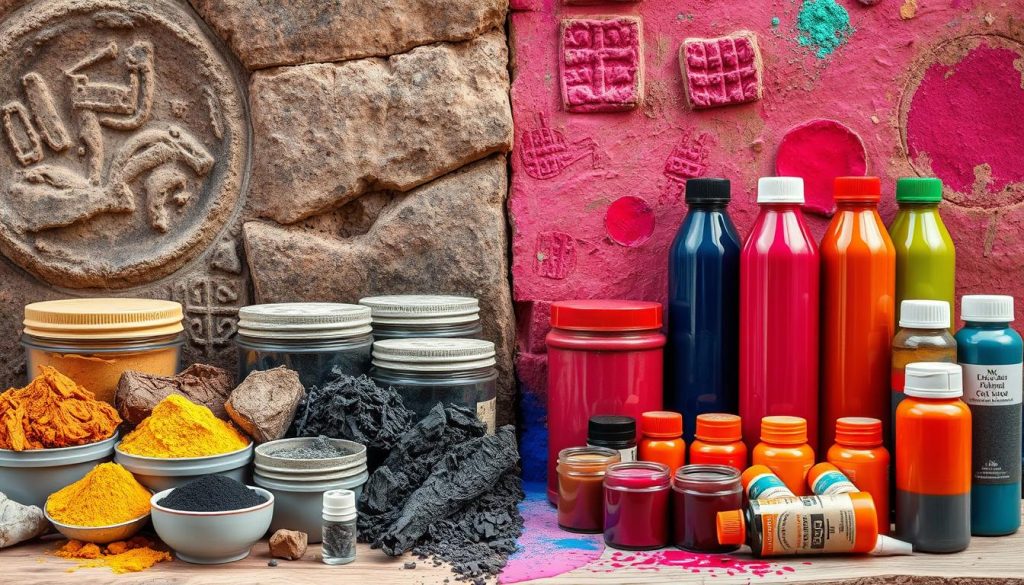
| Aspect | Natural Pigments | Man-Made Pigments |
|---|---|---|
| Source | Manganese, Hematite, Wooden Coal, Animal Fat | Synthesized from available materials |
| Durability | High | Variable |
| Color Range | Rich and earthy tones | Distinct and varied shades |
These methods and materials tell us a lot. They show why the Bhimbetka shelters are key to history and culture.
Significance of Bhimbetka Caves
The Bhimbetka caves show how people have changed over time. There are over 750 rock shelters here. They cover 10 kilometers. They have ancient rock paintings and very old fossils.
These caves show how people moved from moving around to farming. And how their beliefs in gods and nature grew. It’s all recorded on the cave walls.
Cultural Evolution
The stories in Bhimbetka caves are very special. They have rock paintings that are up to 10,000 years old. The oldest is more than 12,000 years old. These paintings show many things from long ago.
They show people hunting and farming. They even show men on horses and elephants from the Mesolithic period. By looking at their art, we understand how clever and developed early humans were.
Spiritual Expressions
The caves also tell us about old spiritual beliefs. They have paintings from when Hinduism and Buddhism started to influence people. You can see art of tree gods and sky chariots.
This shows us how art and spirituality came together back then. The caves are a window to the past. They show us how people thought and believed.
| Key Feature | Details |
|---|---|
| Number of Caves | Over 750 rock shelters |
| Area Covered | 10 kilometers |
| Periods Depicted | Paleolithic, Mesolithic, Chalcolithic, Early Historic, Medieval |
| Oldest Painting | Over 12,000 years old |
| Significant Site | UNESCO World Heritage Site since 2003 |
In summary, Bhimbetka’s caves are like a history book. They tell us how people lived long ago. And how they thought about the world and the divine. It’s a key place to understanding human history.
Notable Rock Art Sites within Bhimbetka
The Bhimbetka rock shelters are full of ancient art. They are in the Vindhya Range forests. These shelters have old paintings that show how early humans lived.
The Auditorium Cave
The Auditorium Cave is very big and has amazing sound. People call it the ‘cathedral’ of Bhimbetka. It has cool rock shapes and carvings. It’s a key part of Bhimbetka.
Boar Rock (Shelter III F-19)
Boar Rock is known for its boar painting that looks like a myth. It mixes features from different animals. This art is full of imagination. Boar Rock helps us understand ancient symbols. It’s a must-see in Bhimbetka.
Zoo Rock
Zoo Rock shows lots of animals and people. It has 453 figures in total. You can see 252 animals from 16 types, and 90 humans. This rock talks about the area’s old animals and people. It shows art changing over thousands of years.
| Site Name | Features |
|---|---|
| The Auditorium Cave | Grand rock formations and cathedral-like structure |
| Boar Rock (Shelter III F-19) | Depiction of a mythical creature |
| Zoo Rock | 453 figures depicting various animals and humans |
Visiting Bhimbetka’s shelters teaches us about old art and beliefs. It tells us about people from long ago in India.
Major Findings and Excavations
Bhimbetka’s findings tell us about ancient human life. Many tools, artifacts, and ancient art were found in Bhimbetka rock shelters. These discoveries show how humans went from wandering to farming together.
Stone Tools and Artifacts
At Bhimbetka, very old stone tools were found. They come from a time called the Acheulean era. Tools like axes and scrapers show early humans were clever makers.

More items found are from the Mesolithic and Chalcolithic periods. Among them are tiny stone tools, pottery with designs, and copper things. This points to better skills and more complex society structures.
Evidence of Agricultural Transition
Findings at Bhimbetka show farming started in the Chalcolithic period. Rock art there shows farming scenes and taming animals.
They found bones of deer, boar, and antelope too. This suggests what the early farmers ate. Moving to farm life was a big step for humans.
| Period | Key Findings |
|---|---|
| Lower Palaeolithic | Hand axes, choppers, scrapers |
| Mesolithic | Haematite pieces, communal dance depictions, pregnant women depictions |
| Chalcolithic | Microliths, painted pottery, copper objects |
| Maurya/Sunga | Small stupas, iron arrowheads, red and grey ware ceramics |
| Medieval | Stone images of Ganesha, hunting scenes, Brahmanical gods paintings |
Discoveries at Bhimbetka give us valuable knowledge about our ancestors. The work done here has greatly added to what we know about early human societies.
Natural Surroundings and Environment
The Bhimbetka rock shelters are in the beautiful Vindhya Range. This area is a UNESCO World Heritage Site. It has five hills and is more than 600 meters high. The nature around Bhimbetka is important for its history and culture.
The Vindhya Range
The Vindhya Range has rugged landscapes. It’s more than a place with great views. It has a long human history.
The Bhimbetka rock shelters cover 1892 hectares. They show human life from the Stone Age to later times. The art on the rocks shows hunting, dancing, and everyday life long ago.
The rocks at Bhimbetka are almost 100 meters tall. They show how people used nature creatively.
Ratapani Wildlife Sanctuary
The Ratapani Wildlife Sanctuary is around Bhimbetka. It has forests and many animals like leopards and tigers. This place helps protect Bhimbetka’s history.
The sanctuary’s nature helped Bhimbetka’s people thrive. It has fields and forests for food and shelter. These conditions helped people build a community long ago.
The Ratapani Wildlife Sanctuary helps keep the area beautiful. It shows how nature and human history are connected. This makes the rock shelters very special.
Modern-Day Relevance and Preservation
The Modern-day relevance of Bhimbetka rock shelters is clear. They show how early humans showcased their world. They depicted hunting, music, dancing, horse riding, and ritual practices.
These shelters have paintings from the Mesolithic period. They show over 100,000 years of human history. Located near Bhopal, these shelters mix tourism with education.
UNESCO and the ASI now work to preserve these shelters. Since 2003, when Bhimbetka became a UNESCO site, there have been many preservation efforts. These help tourists visit without harming the site.
- Guided tours: Offering in-depth knowledge from local guides with multilingual information boards.
- Infrastructure developments: Enhancing visitor experience while ensuring the shelters remain unharmed.
- Modern technology integration: Plans for virtual tours and augmented reality apps to provide a comprehensive yet protective way to experience the site.
- Controlled access: Visitors can explore only 12 to 15 rock shelters, ensuring minimal impact on the overall site.
Tourism has helped local communities financially. It marries economic growth with preservation of Bhimbetka rock shelters. The ASI helps by maintaining the art and teaching people about the site’s importance.
The Modern-day relevance of Bhimbetka grows continuously. It shows human creativity and our survival journey. Thanks to ongoing efforts, our future generations will also experience this history.
Conclusion
The Bhimbetka rock shelters cover 10 square kilometers with more than 750 shelters. They show humanity’s early art and culture over 30,000 years. Scenes of daily life, animals, and ceremonies are all captured here. In 2003, these caves became a UNESCO World Heritage Site. This shows how important they are for understanding early humans.
The rock art at Bhimbetka is very old but well-kept. People lived here for over 100,000 years. The art from around 8,000 BCE is some of the oldest known. Scholars and visitors are amazed by the skill of early humans.
Today, efforts are made to keep the Bhimbetka rock shelters safe for the future. This helps keep the art safe and allows for careful tourism. Fossils here add to its value, making Bhimbetka key for learning about early humans. This place inspires many interested in ancient art and history.
FAQ
Where are the Bhimbetka rock shelters located?
The Bhimbetka rock shelters are in the Raisen District, Madhya Pradesh, India. They are about 45 kilometers southeast of Bhopal. You can get there from Obedullaganj city.
What is the historical significance of the Bhimbetka rock shelters?
The Bhimbetka rock shelters became a UNESCO World Heritage Site in 2003. They show signs of human life dating back over 100,000 years. This reveals our evolution from the Stone Age to now.
How many rock shelters are there in the Bhimbetka site?
There are over 750 rock shelters at Bhimbetka. They spread across seven hills.
What types of art are present in the Bhimbetka rock shelters?
The rock art at Bhimbetka shows hunting, dancing, and ceremonies. These scenes span seven periods. They include the Upper Paleolithic to the Medieval periods.
What materials were used to create the rock paintings at Bhimbetka?
Artists used natural pigments from minerals and plants for the rock paintings. They applied these with twigs, feathers, and brushes made from hair.
Which notable rock art sites can be found within Bhimbetka?
Noteworthy sites include the Auditorium Cave, known for its grandeur. Boar Rock (Shelter III F-19) shows a mythical creature. Zoo Rock displays various wild animals.
Who discovered the historical importance of the Bhimbetka rock shelters?
V. S. Wakankar discovered the Bhimbetka rock shelters’ importance in the mid-20th century. His discovery led to more archaeological research and findings.
What does the art at Bhimbetka indicate about early human life?
The art shows the shift from nomadic life to farming and spiritual practices. It highlights influences from Hinduism and Buddhism over time.
What are some major archaeological findings at Bhimbetka?
Excavations revealed stone tools from the Acheulean era. They also found evidence of early farming in the Chalcolithic period.
What role does the natural environment play in Bhimbetka’s history?
The natural environment has been key to early human life at Bhimbetka. The shelters lie by the Vindhya Range and Ratapani Wildlife Sanctuary. The nearby teak forests and fields helped early humans survive.
What efforts are being made to preserve the Bhimbetka rock shelters?
UNESCO and local officials are working to save the Bhimbetka rock shelters. Their goal is to protect this glimpse into early human history for future generations.