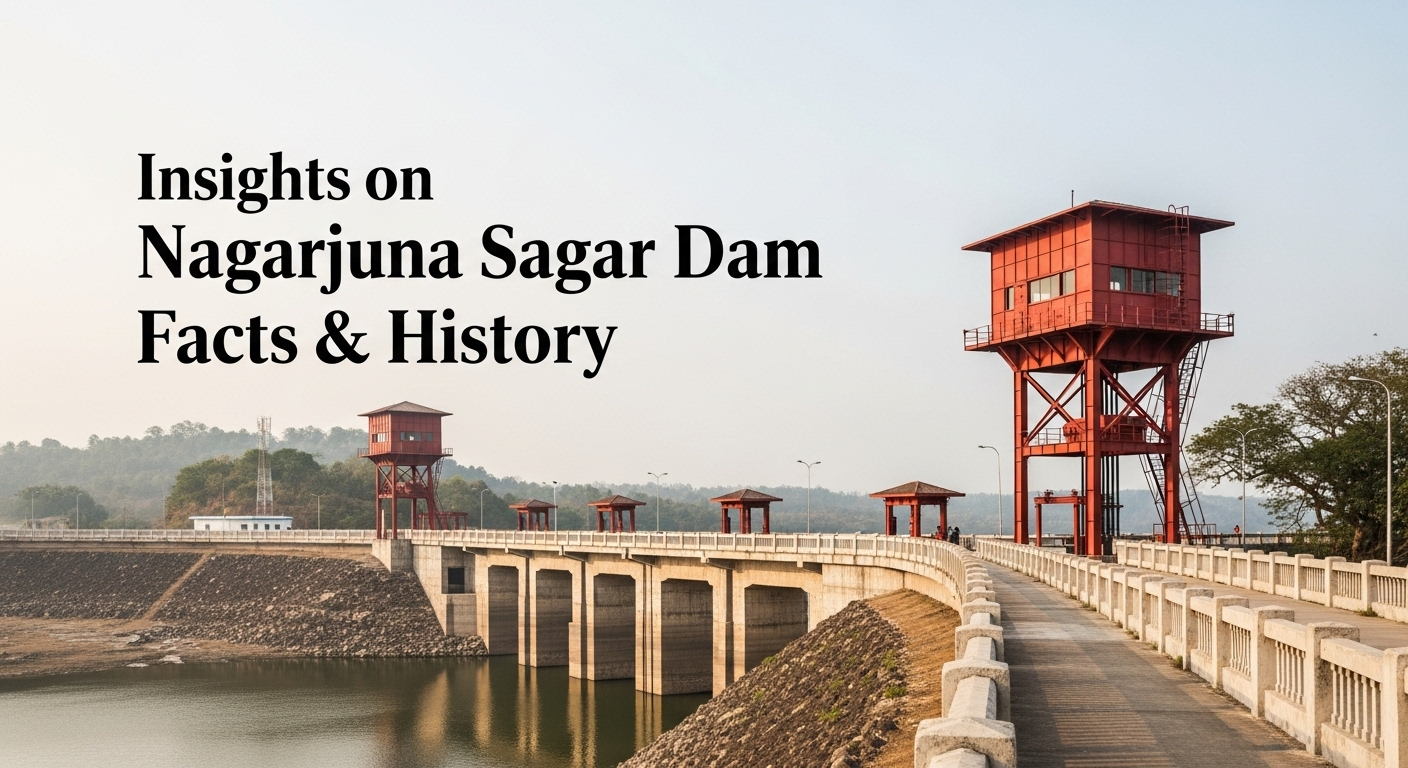
Did you know the Nagarjuna Sagar Dam is in Telangana? It’s one of Asia’s key man-made structures. Next only to the Bhakra Nangal dam. This huge dam makes a big lake. It’s very important for watering crops and making electric power in India. Its history is as grand as it looks. It has changed the local economy and buildings.
The dam’s story began with the British and ended after India became free. It shows India’s push towards being modern and self-reliant. It has helped farms grow and make more energy. This is a big part of the Green Revolution. The dam’s history is full of important events and people showing its value today.
Key Takeaways
- Nagarjuna Sagar Dam is one of the significant dams in India, located in Telangana.
- The dam has been pivotal in agricultural transformation through extensive irrigation.
- It plays a crucial role in hydroelectric power generation in India.
- Nagarjunakonda Island near the reservoir preserves ancient artifacts dating back to the 2nd and 3rd centuries BC.
- The Ethipothala Waterfall near Nagarjunasagar town drops approximately seventy feet, creating a tranquil attraction.
- The Nagarjunasagar-Srisailam Tiger Reserve is one of India’s largest tiger reserves, offering wildlife experiences.
Introduction to Nagarjuna Sagar Dam
The Nagarjuna Sagar Dam is a modern marvel in engineering. It is found where Guntur district in Andhra Pradesh and Nalgonda district in Telangana meet, India. It makes hydroelectricity and helps in irrigation. This shows a big step in managing water and growth in the area since it was built.
Location and Basic Information
The dam’s location is at 16°34′32″N 79°18′42″E. It is 124 meters (407 feet) tall and 1,550 meters (5,085 feet) long. It is important for the Krishna River Basin, which covers about 258,948 square kilometers.
The water surface of the dam is 285 square kilometers. It can hold 11.56 cubic kilometers of water. Known as the largest masonry dam in the world, it stores up to 11,472 million cubic meters of water. Visitors also enjoy boating on the large water reservoir.
Purpose and Construction Timeline
Work on the dam started in 1955, marking the beginning of a big project. This project changed farming and energy in the area over twelve years. It was finished in 1967, with Prime Minister Jawaharlal Nehru leading the effort.
The dam was built to water 9.81 lakh acres of land and make 816 MW of power. The project’s cost was 132.32 crore rupees. This shows the big dream and work behind the dam.
Visiting the Nagarjuna Sagar Dam also teaches people interesting facts. It shows its big role in farming and making electricity in the area.
Nagarjuna Sagar Dam History
The Indira Gandhi Nagarjuna Sagar Dam has a history as deep as its purpose. It took many years of planning and building. The dam shows the strong British engineering used in India. It also shows the dreams of key Indian leaders who wanted it built.
Initial Surveys and British Involvement
In 1903, British engineers first thought of using the Krishna River. This idea didn’t move forward until India became free. After that, India started to build important structures.
Construction Phase and Key Figures
Prime Minister Jawaharlal Nehru started the dam’s building in December 1955. A key person, Raja Vasireddy Ramagopala Krishna Maheswara Prasad, helped a lot. He gave a lot of land and money for the dam.
The dam was finished in 1967. It was a big success. But, 52 villages went underwater, and many people had to move. The water covered Nagarjunakonda too. This place had old artifacts from the 3rd century AD.
| Aspect | Details |
|---|---|
| Construction Period | 1955 to 1967 |
| Height | 124 meters |
| Length | 1,550 meters |
| Number of Gates | 26 |
| Reservoir Capacity | 11,472 million cubic meters |
Importance of Nagarjuna Sagar Dam
The Nagarjuna Sagar Dam is very important, especially for farming and making electricity. It helps India grow more food and also creates a lot of power from water.
Impact on Agriculture through Irrigation
The dam is a big deal for India’s farmers. It changed the way farming is done in nearby areas. Thanks to the dam, dry lands now grow lots of crops.
Contribution to Hydroelectric Power Generation
The dam also makes a lot of electricity using water. This power is a big help for the region. It shows how the dam helps in many ways.
| Nagarjuna Sagar Dam Statistics | Details |
|---|---|
| Height | 124 meters |
| Length | 1450 meters |
| Crest Gates | 26 |
| Reservoir Capacity | 11,472 million cubic meters |
| Power Generation Capacity | 1000 megawatts |
| Major Canals | Jawahar, Lal Bahadur Shastri |
| Nearest Airport | Hyderabad, 153 km away |
| Nearest Railway Stations | Macherla (23 km), Nalgonda (83 km) |
Facts about Nagarjuna Sagar Dam
The Nagarjuna Sagar Dam stands tall in India. It’s known for its great engineering. Built in 1969, it’s in the Nalgonda district. It’s big and can hold a lot of water.
Structural Specifications
The dam is 124 meters high and 1,550 meters long. It has 26 big floodgates. Each gate is really tall and wide. The dam helps manage water and prevent floods. Up to 70,000 workers helped build it. This shows how big of a project it was.

Water Storage Capacity
The dam’s reservoir can hold 11,472 million cubic meters of water. It’s one of the biggest in the world. The water is used for farms, drinking, and businesses. The Krishna River Management Board shares this water between Telangana and Andhra Pradesh.
Environmental Impact
The dam helps save water and make energy. But it also causes some problems. Changing the river flow and storing lots of water has polluted groundwater. It has also hurt local nature. Building the dam meant moving 52 villages. This shows it had a big effect on people and nature.
Nagarjuna Sagar Dam Construction Details
The Nagarjuna Sagar Dam construction shows amazing dam engineering in India. It’s the world’s largest masonry dam. This project started in 1952 and ended in 1969, taking 17 years of hard work.
A key part of the Nagarjuna Sagar Dam history is its huge build. About 45,000 workers helped at its busiest. The dam is 490 feet tall and 6 feet thick. It stretches over 10 miles with 26 big gates.
| Construction Aspect | Details |
|---|---|
| Project Start | 1952 |
| Project Completion | 1969 |
| Height | 490 ft. |
| Thickness | 6 ft. |
| Length | 16 km |
| Number of Gates | 26 |
| Workers | 45,000 at peak |
| Cost | 1300 crore rupees |
The project was made to manage a lot of water. It waters a big area of land. The reservoir takes up over 10 lakh acres in four districts. They used new methods like moving the river to keep building smoothly.
A big part of the work was in hydrology and masonry. The dam can let a huge amount of floodwater pass safely. It has 26 bays, and each is important for managing water. The engineering efforts set high standards for future projects in India.
It’s important to see how many jobs this project created. About 24,000 people moved from 52 villages. Even with the big task and detailed planning, relocation was done by 2007. It’s a major event in dam engineering in India.
Nagarjuna Sagar Dam Benefits
The Nagarjuna Sagar Dam has changed many lives. It has boosted the economy and the area’s growth in India. It has helped farmers grow more crops and create electricity.

Economic Upliftment
The Nagarjuna Sagar Dam has greatly helped the economy. It makes farming better by providing water. This helps farmers grow more types of crops.
They earn more money and live better lives. The dam also creates electricity. This electricity has helped start new businesses. It makes more jobs for people.
Regional Development
The dam has helped the region grow. It has led to better roads and ways to communicate. Thanks to the dam, there is always enough water.
This means less trouble from droughts. The growth has brought more investment and help to the community. People now have better access to schools and hospitals.
| Component | Statistics |
|---|---|
| Construction Completion Year | 1967 |
| Initial Water Level | 510 feet |
| Current Water Level | 535 feet |
| Storage Capacity | 178 TMC out of 312 TMC |
| Hydroelectric Power Generation | Significant |
The Nagarjuna Sagar Dam economic impact has made lives better. It keeps bringing growth to the area. This makes the dam very important in India.
Nagarjuna Sagar Dam Tourism Information
The Nagarjuna Sagar Dam is an amazing engineering work. It’s a key spot for those who love beauty and history. Everyone should visit it to see nature and the past come alive.
It sits between Telangana and Andhra Pradesh. This area offers beautiful nature, old stories, and historic places. There are many beautiful views and important spots nearby, perfect for a full tour.
Visitors will find many special places around the dam. This includes the beautiful Ethipothala Waterfalls and the holy Srisailam town. These places, set against stunning views, make the trip great for families and history lovers.
Planning your visit? There are tour packages. For example, a two-day tour (Tour Code: TS02) includes the dam, Ethipothala Waterfalls, and Srisailam. It starts at 06:00 Hrs. This lets you enjoy the area’s beauty and history.
Getting to the dam is easy. The closest airport is in Hyderabad, 150 kilometers away. The nearest train station is Macherla, just 24 kilometers from the dam. This makes visiting Nagarjuna Sagar Dam easy for travelers.
Nagarjuna Sagar tourism shows off the dam’s great design. It also leads to adventures in nature and culture. This makes visiting here a rich and unforgettable adventure for everyone.
Nagarjuna Sagar Dam Facts and Figures
The Nagarjuna Sagar Dam is a huge engineering marvel in India. It sits on the Krishna River. The dam is 124 meters tall and stretches over 1,450 meters in length. This makes it one of the world’s biggest masonry dams.
The dam’s catchment area is vast, measuring 215,185 square kilometers. The area sees up to 889 mm of rainfall yearly. This helps fill the dam’s huge storage capacity. As of 2011, the dam can hold 180.376 TMC of live storage. Dead storage is at 131.669 TMC. The reservoir can spread over 285 square kilometers.
The dam is also big on hydroelectric power. It can generate up to 815.6 MW with its main plant. Eight units started between 1978 and 1985 produce this power. Two more stations add 150 MW to the total. This shows how important the dam is for power production.
For flood management, this dam is very prepared. It can handle a flood discharge of 30,050 Cumecs. Its design allows for a max of 58,340 Cumecs. These features help manage floods well.
During its peak construction phase, the project employed around 45,000 workers.
Irrigation is another big benefit of the dam. The right canal alone waters 4500 square kilometers. The left canal adds 1300 square kilometers to this. Telangana gets 105.70 TMC of water, while Andhra Pradesh gets 174.30 TMC. This greatly helps both states.
The dam’s construction initially made 52 villages go underwater. This affected 24,000 people. But by 2007, everyone was successfully moved to new homes.
The spillway of the dam is very long, at 1545 ft. This is key to the dam working so well. The facts show the dam’s big impact on India’s power, irrigation, and flood control.
| Aspect | Specification |
|---|---|
| Height | 124 meters (407 ft) |
| Length | 1,450 meters (4,760 ft) |
| Catchment Area | 215,185 sq km |
| Max Annual Rainfall | 889 mm (35 inches) |
| Live Storage Capacity | 180.376 TMC |
| Dead Storage Capacity | 131.669 TMC |
| Water Spread Area | 285 sq km |
| Peak Construction Workers | 45,000 |
| Power Generation | 815.6 MW (Main Plant), 90 MW (Right Canal), 60 MW (Left Canal) |
| Flood Discharge (Observed) | 30,050 Cumecs (10.61 Lakh Cusec) |
| Max Designed Discharge | 58,340 Cumecs (20.60 Lakh Cusec) |
| Spillway Length | 1545 ft (470.916 m) |
Conclusion
The Nagarjuna Sagar Dam is a huge success among India’s engineering feats. Its building changed the land and helped the area’s people and economy. The dam is tall at 490 feet and long at 1.6 kilometers. It does a lot, like watering farms and making power. This helps millions and keeps farming going in the Krishna Delta.
The dam’s role goes beyond just its uses. It’s a key part of the area’s growth and engineering. It waters 1.3 million acres, boosting the economy and farming. Also, using Water Powered Pump units shows new ways to use water storage.
The area around the dam, the Nagarjunsagar-Srisailam Tiger Reserve, is rich in life and history. It covers 3,728 km². It’s home to tigers and historic places like King Pratap Rudra’s Fort. The reserve’s benefits to the area are worth Rs 16,041.15 crore a year.
The Nagarjuna Sagar Dam stands for big growth and smart ideas. To learn more about other important Indian dams, go here. India’s move towards careful growth needs to think about nature, society, and the economy. What we learn from this dam will help with future projects in the country.
FAQ
What are some notable facts about Nagarjuna Sagar Dam?
Nagarjuna Sagar Dam is among the world’s biggest masonry dams. It has 26 floodgates. Built over 12 years, it was finished in 1967. It’s key for irrigation and making hydroelectric power in India.
Where is Nagarjuna Sagar Dam located?
The dam is on the border of Guntur and Nalgonda districts, Andhra Pradesh and Telangana, India. It uses Krishna River waters.
What is the historical significance of Nagarjuna Sagar Dam?
Plans to use the Krishna River started in 1903 by British engineers. Construction kicked off in 1955, with Prime Minister Nehru leading. Finished in 1967, it pushed India’s Green Revolution, promoting modern farming and food self-sufficiency.
How has Nagarjuna Sagar Dam impacted agriculture?
The dam changed farming nearby with its big irrigation network. The Jawahar and Lal Bahadur Shastri canals irrigate lots of land. This ups farm output and supports the local farm economy.
What is the contribution of Nagarjuna Sagar Dam to hydroelectric power?
It can make up to 1000 megawatts of clean energy. This powers growth and industry in the area.
What are the structural specifications of Nagarjuna Sagar Dam?
The dam is made of stone and is very tall and long. It has 26 big floodgates to control water well.
What is the water storage capacity of Nagarjuna Sagar Dam?
It can hold a lot of water. This is key for managing water, irrigation, and making power.
What environmental impacts are associated with Nagarjuna Sagar Dam?
Building and using the dam has raised big eco worries. These include harming groundwater and changing river flows, which hurts local nature.
How has the construction of Nagarjuna Sagar Dam influenced economic upliftment?
The dam has boosted the economy by making farming better, raising industry output, and bettering life in the area. This has hugely helped in socio-economic growth.
What role does Nagarjuna Sagar Dam play in regional development?
The dam goes beyond its main uses. It has boosted productivity and stability for local communities. This helps the area’s socio-economic growth.
Is Nagarjuna Sagar Dam a tourist attraction?
Yes, it’s a famous spot that draws visitors. Places around it offer great culture, history, and nature. This makes it a perfect place for tourists.
What are some key figures related to Nagarjuna Sagar Dam’s operations?
Its large water and power numbers are impressive. The dam helps manage water well and makes about 1000 megawatts of power. It plays a big part in helping the area grow.