Did you know the Pancha Rathas in Mahabalipuram are made from huge granite blocks? Each tower was carved from one stone. This shows the Pallava Dynasty’s smart work back in the 7th century. Mahabalipuram is full of old secrets and cool buildings. It shows us a rich history that many people don’t notice.
When you dive into Mahabalipuram, you see amazing temples and statues. This article talks about Mahabalipuram’s history, its cool buildings, and stories. We will see how the Pallava dynasty left its mark. We’ll also look at Mahabalipuram’s role in arts and sea trade. Get ready to be amazed and learn a lot.
Key Takeaways
- The Pancha Rathas showcase architectural brilliance from the 7th century.
- Mahabalipuram’s Shore Temple is the oldest stone temple in South India.
- Rich in cultural heritage, Mahabalipuram features unique rock-cut sculptures.
- These historical sites are imperative in understanding the Pallava dynasty’s legacy.
- The region plays a vital role in ancient maritime trade routes.
- Mahabalipuram has been designated a UNESCO World Heritage Site.
- Local legends add to the allure of its numerous historical landmarks.
Introduction to Mahabalipuram’s Historical Significance
Mahabalipuram is on the east coast of India in Tamil Nadu. It’s an important part of ancient maritime trade history. This town was vital for trade with countries like Persia and Southeast Asia. The Mahabalipuram historical significance comes from its trade history and its mix of art and architecture from the Pallava dynasty.
The unknown stories of Mahabalipuram are told through its grand monuments and sculptures. These works share tales from a time of cultural exchange and artistic greatness. The Group of Monuments at Mahabalipuram shows the Pallavas’ architectural skill.
Among its wonders, the Five Rathas are very special. They show the religious and artistic styles of that time. Each ratha honors different deities with unique styles and detailed sculptures. The Varaha Cave Temple, for Lord Vishnu, has beautifully carved pillars. These add to the cultural richness of Mahabalipuram.
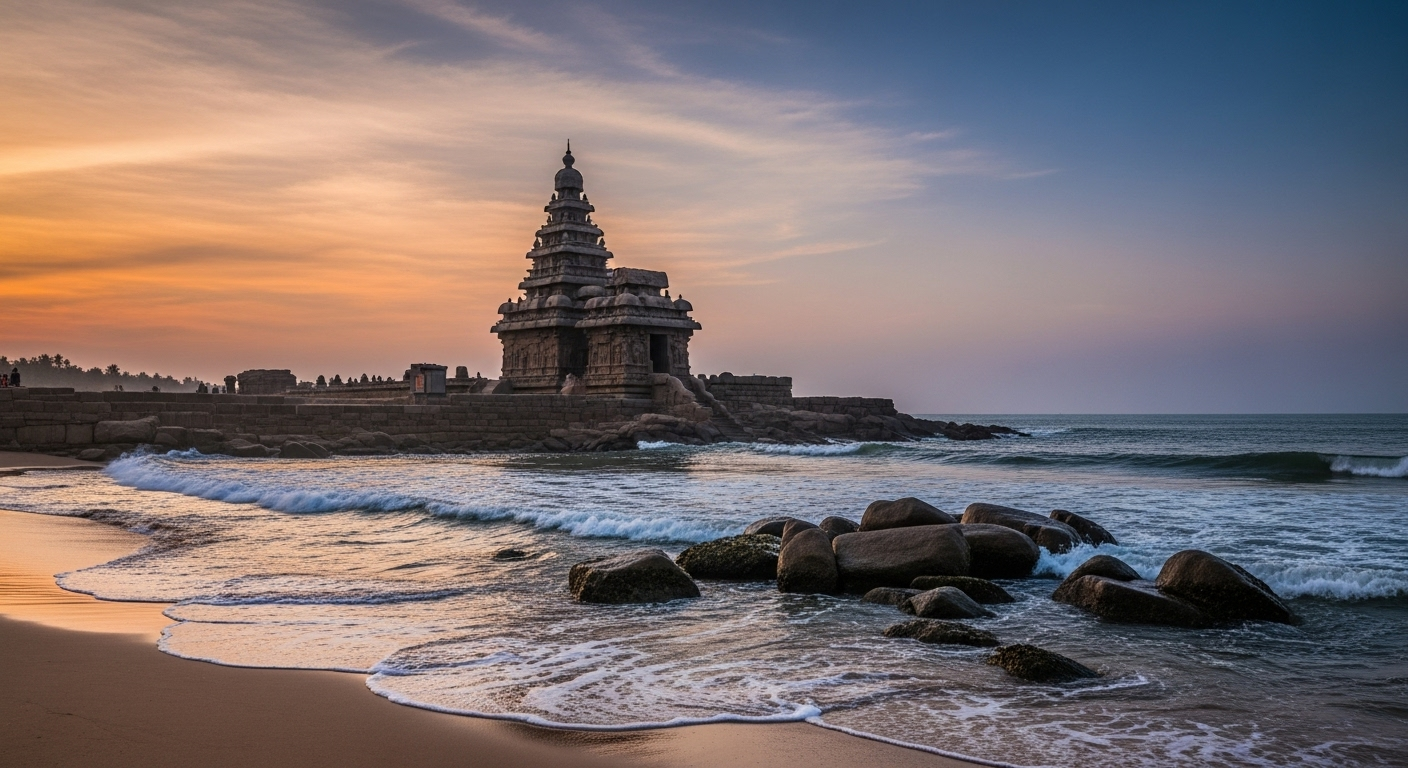
The Shore Temple stands as a great work from 700-728 CE. It has shrines for Lord Shiva and Lord Vishnu. Arjuna’s Penance is another marvel. It has a huge bas-relief showing stories from Hindu mythology. This highlights the time’s narrative artistry.
Since 1984, Mahabalipuram has been a UNESCO World Heritage Site. It faces problems like coastal weathering. The Archaeological Survey of India’s efforts aim to keep the historical sites safe. The Mahabalipuram Dance Festival celebrates the town’s rich culture. It draws artists from across the country.
In the 19th century, archaeology boosted Mahabalipuram’s appeal for tourists. Now, there are efforts to make tourism sustainable. Improvements and support for local artisans are making the town’s future bright. Visitors get to learn about ancient Indian history through its architectural wonders.
The Origins of Mahabalipuram
Mahabalipuram’s history began in the 7th century AD under the Pallava dynasty. King Narasimhavarman I led this era of art and culture. The origins of Mahabalipuram are found in its role as a creative and trading hub.
Archaeological finds show the early life of this coastal town. Mahabalipuram was part of ancient trade routes. This helped it grow as a port city. Many merchants visited, bringing new ideas and goods.
https://www.youtube.com/watch?v=uTjETa0KVLk
Mahabalipuram is more than its historic buildings. It tells of resilience and artistic greatness. The Mahabalipuram ancient secrets are in its carvings and temples. They share tales of the past. This town’s history shows us the power of art over time.
Architectural Marvels and Their Secrets
Mahabalipuram is known for its ancient buildings, especially its rock-cut temples. These temples show how art and engineering can mix. They remind us of the Pallava dynasty’s greatness. The Shore Temple is especially famous for its history and culture.
Significance of the Rock-Cut Temples
The rock-cut temples in Mahabalipuram show the skill of old artisans. Made from granite cliffs, these temples account for Indian rock architecture. Not just holy places, they also mirror the social and political life back then.
- Each temple presents intricate carvings, illustrating mythological stories.
- The construction techniques used are believed to date back to the 7th century.
- They contribute significantly to the understanding of early Dravidian architecture.
The Shore Temple: A Historical Perspective
The Shore Temple was built during King Narsimha-Varman II Rajasimha’s rule. It is among the oldest structural temples in South India. Being a UNESCO World Heritage Site, it shows the best of Pallava architecture. It has two main temples for Lord Shiva with beautiful carvings. This place helps us see how religious buildings evolved in Tamil Nadu.
| Aspect | Details |
|---|---|
| Construction Period | 7th Century AD |
| Architectural Style | Pallava Architecture |
| Significant Features | Intricate carvings, two main temples dedicated to Shiva |
| UNESCO Status | Designated World Heritage Site |
Unknown History of Mahabalipuram
The history of Mahabalipuram is filled with myths and legends. This coastal town is known for its ancient temples and beautiful rock architecture. Stories mix with real history, making it more than just an archaeological site.
Unraveling the Myths and Legends
Many local stories say Mahabalipuram was made by gods and demons. One story talks about Vishwakarma, the divine builder of its temples. There are also tales of hidden treasures and sunken cities, attracting historians and treasure seekers.
Mahabalipuram and the Pallava Dynasty
The Pallava dynasty was key to the area’s growth in culture and architecture from the 7th to 9th centuries. They were great promoters of art and architecture. Their work includes the amazing shore temples and rock monuments. Back then, Mahabalipuram was a major seaport, linking India to far-off places. The Pallavas’ artistic legacy can be seen in the city’s detailed carvings and sculptures.

Exploring Mahabalipuram’s Archaeological Mysteries
Mahabalipuram is known for its ancient architecture and maritime history. Over time, many discoveries have been made here. These have given us new information about the past. They show how important the city was in trade and spirituality long ago.
Discoveries That Changed Historical Narratives
The Shore Temple is a major find in Mahabalipuram. It was built between 700 and 728 AD. The temple shows the amazing skills of early craftsmen. It is part of a UNESCO World Heritage Site. The temple displays the beauty of Dravidian architecture and the culture of the Pallava dynasty.
The five monolithic chariots, or Pancha Rathas, also stand out. They represent different Hindu deities. These findings help us understand the religions of ancient people better. They have also helped fix the timeline of the city’s history.
Proposed Theories on Lost Structures
There are theories about Mahabalipuram’s lost structures under the sea. Some experts think exploring underwater might reveal old buildings. These could change what we know about the city’s trading history.
People keep looking for more sites nearby. The mystery of these lost structures sparks interest in Mahabalipuram’s past. Everyone is curious about its role in trade and cultural exchange. Someday, these secrets may be discovered.
The Hidden Facts Behind Mahabalipuram’s Art
Mahabalipuram’s art tells deep stories with its sculptures and reliefs. Every artwork there has a tale. It shares the cultural and spiritual ideas of its time. If we understand this, we see how traditions shaped the art in Mahabalipuram.
Symbolism in Sculptures and Reliefs
The sculptures in Mahabalipuram are more than just art. They tell stories in stone. With symbols from myths, daily life, and gods, they show what people valued back then. This tells us a lot about the culture of that era, especially through Mahabalipuram art.
- Divine Representation: Many sculptures show gods, highlighting spiritual beliefs.
- Mythological Stories: Reliefs show epic tales, revealing how people told stories.
- Cultural Significance: Art captures everyday life, showing what fishermen and merchants did.
Influence of Local Legends on Artistic Expressions
The art in Mahabalipuram connects deeply with local stories. These legends inspire the art, making it alive with history. This reflects the heroic acts and lessons from those tales.
| Legend | Artistic Expression | Symbolism |
|---|---|---|
| The Descent of the Ganges | Relief depicting Bhagiratha bringing Ganga to Earth | Represents perseverance and devotion |
| The Killing of Narasimha | Sculpture of Narasimha defeating Hiranyakashipu | Symbolizes the triumph of good over evil |
| Shiva and Parvati | Intricate carvings illustrating divine harmony | Embodies balance and unity in relationships |
Mahabalipuram’s Enigmatic Past
The enigmatic past of Mahabalipuram stirs up lots of thoughts. It’s known for its amazing stone work and temples. These pieces raise questions about how people lived back then. The Pancha Rathas show the skill of the Pallava Dynasty from the 7th century. They are made from big granite blocks. People wonder what they were for and their importance in culture.
When people visit Mahabalipuram, they feel a strong link to its rich history. The Shore Temple is a key historical site. King Narsimha-Varman II Rajasimha built it. There are also legends about the Seven Pagodas. A storm is said to have hidden all but the Shore Temple.
Exploring Mahabalipuram raises many questions. Why did it become a key place for cultural meetings? How did its building style bring together different historical periods? These mysteries make us want to learn more. To understand the architecture, visitors should see the famous sites. Discover more about this fascinating journey here.
The Role of Mahabalipuram in Maritime Trade
Mahabalipuram was a key trading port, linking India with Southeast Asian countries. It was located perfectly for trade across the seas. Through this vibrant trade, cultures met and goods were exchanged. This made Mahabalipuram a lively place of commerce and culture.
The port was busy with the trade of spices, textiles, and metals. Artisans and traders from around the world gathered here. They brought different cultures together. This made Mahabalipuram rich in commerce and craft.

The trade routes influenced its architecture. The Shore Temple, from the 8th century AD, was a guide for sailors. It stood where trade and faith met.
Today, festivals in the area draw people from all over. This shows how trade and culture have always mixed here. Mahabalipuram keeps innovating in tourism and trade. Yet, its historical role in maritime trade stands tall.
| Goods Traded | Historical Significance |
|---|---|
| Spices | Integral to culinary practices, enhancing trade relations with Southeast Asia |
| Textiles | Showcased local craftsmanship, leading to a flourishing textile trade |
| Precious Metals | Served as currency for trade, reinforcing economic connections |
Modern Interpretations of Historical Events
People now see Mahabalipuram’s history in new ways. Historians and archaeologists find new things that change what we know about this old city. Modern technology helps a lot in finding these new insights.
Satellite imagery and marine archaeology help find lost buildings and study hidden spots. These discoveries allow for a better understanding of Mahabalipuram’s geography and culture. By looking at artifacts and the way buildings were made, experts can learn about Mahabalipuram’s past from different angles. This includes both written records and what we can see from the area itself.
Several things shape how experts study this today:
- Better imaging technology uncovers things we couldn’t see before at archaeological sites.
- Working together with scholars from around the world makes research better.
- There’s a bigger interest in keeping cultural history safe. This leads to a new look at old stories.
Modern researchers keep looking at evidence and questioning old ideas. They bring up new thoughts that add to the story of Mahabalipuram. This shows how our understanding of history is always changing.
| Technology | Application | Impact on Interpretation |
|---|---|---|
| Satellite Imagery | Identifying lost structures | Reveals previously unknown sites |
| Marine Archaeology | Exploring submerged areas | Uncovers maritime trade routes |
| 3D Modeling | Reconstructing ancient landscapes | Enhances understanding of spatial relationships |
| Digital Databases | Cataloging artifacts | Facilitates international collaboration |
Conclusion
Mahabalipuram’s secrets show us a city full of history and amazing buildings. Its rock-cut temples and the Pancha Rathas tell us about the Pallava dynasty’s art and culture. Each structure has its own story, showing the area’s rich past and its art and religion contributions.
Mahabalipuram was also key in ancient trade, linking it to far places. People from everywhere visit to celebrate its history. They feel proud to keep these landmarks safe. This invites us all to learn more and protect Mahabalipuram for the future.
Every new discovery in Mahabalipuram proves human creativity and toughness. Scholars and tourists keep digging into its stories. As they do, Mahabalipuram’s secrets get revealed more, adding to India’s historical stories.
FAQ
What is the historical significance of Mahabalipuram?
Mahabalipuram was an important ancient maritime trading port. It was a center for artisans and traders. It made cultural exchanges with countries like Persia and Southeast Asia possible.
What are some archaeological mysteries associated with Mahabalipuram?
Mahabalipuram has mysteries, including structures lost beneath the sea. New finds are changing our understanding of its civilization.
How did the Pallava dynasty influence Mahabalipuram?
The Pallava dynasty, especially under King Narasimhavarman I, made Mahabalipuram a cultural hub. They built amazing rock-cut temples. These show their great artistic talent.
What are some lesser-known facts about Mahabalipuram?
Interesting facts about Mahabalipuram involve ancient legends. It was known for maritime trade. There are also myths about its temples and local stories.
What architectural wonders can be found in Mahabalipuram?
Mahabalipuram has amazing rock-cut temples and the Shore Temple. These structures are beautifully carved. They are important for their cultural and historical value.
What symbolism can be found in Mahabalipuram’s art?
Its art tells cultural stories and values. The sculptures and reliefs often show mythology and local legends. They document the artistic history of the area.
How did maritime trade impact the economy of Mahabalipuram?
Maritime trade helped Mahabalipuram’s economy grow by trading with Southeast Asia. They exchanged spices, textiles, and metals. This made the region wealthy and culturally rich.
What modern technologies are being used to explore Mahabalipuram’s past?
Modern tools like satellite images and marine archaeology are used to study Mahabalipuram. These technologies help us learn more and understand its history better.
Are there any ongoing explorations related to Mahabalipuram?
Yes, explorations are ongoing. They aim to discover Mahabalipuram’s hidden secrets. Studies focus on its history, archaeological sites, and ancient trade paths. This helps preserve its heritage.